
by Simon Pilling, specialist in Japanese lacquer ware
Lacquer – the most perfect and finest objects ever issued from the hand of man (Louis Gonse, L’Art Japonais, 1900)
Lacquer ware has traditionally defined arts of Japan in the West – the western name ‘japanning’ once having as powerful a resonance as ‘china’ still has in defining the art from Japan’s larger neighbour.
Traditional lacquerware is known by its surface finish – frequently highly reflective, with exquisite surface decoration in the form of makie and inlay.
The work of innovative contemporary artist Fujino Seiichiro is inspired by looking beneath the surface, to surprise and intrigue in the relationship between finish and core. It is a contemporary approach that seeks to find the essence of our fascination with an object, exploiting the tension we sense between outer coating and something quite different that lies within.
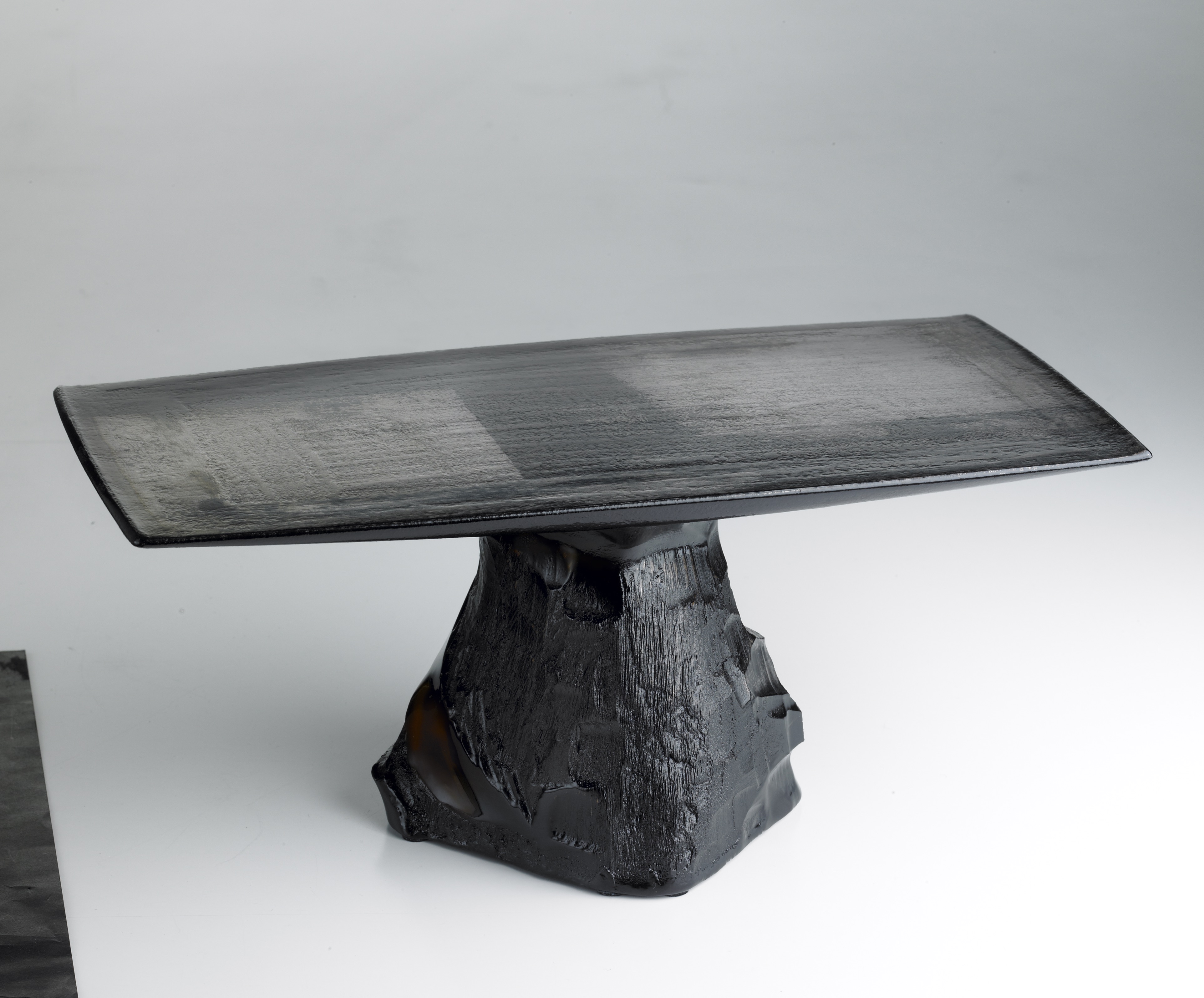
In his Standing Tray a wooden core, that forms the foot of the piece, has been powerfully worked and carved to create a primitive solidity. Some areas are simply coated with lacquer while others are highly worked polished surfaces incorporating coloured and metallic finishes. The tray of the stand, at first sight a regular plane, has a subtly complex and visually very satisfying geometry. Its surface incorporates distressed silver leaf whose patterning could be read as the memories of precious items displayed in the past.
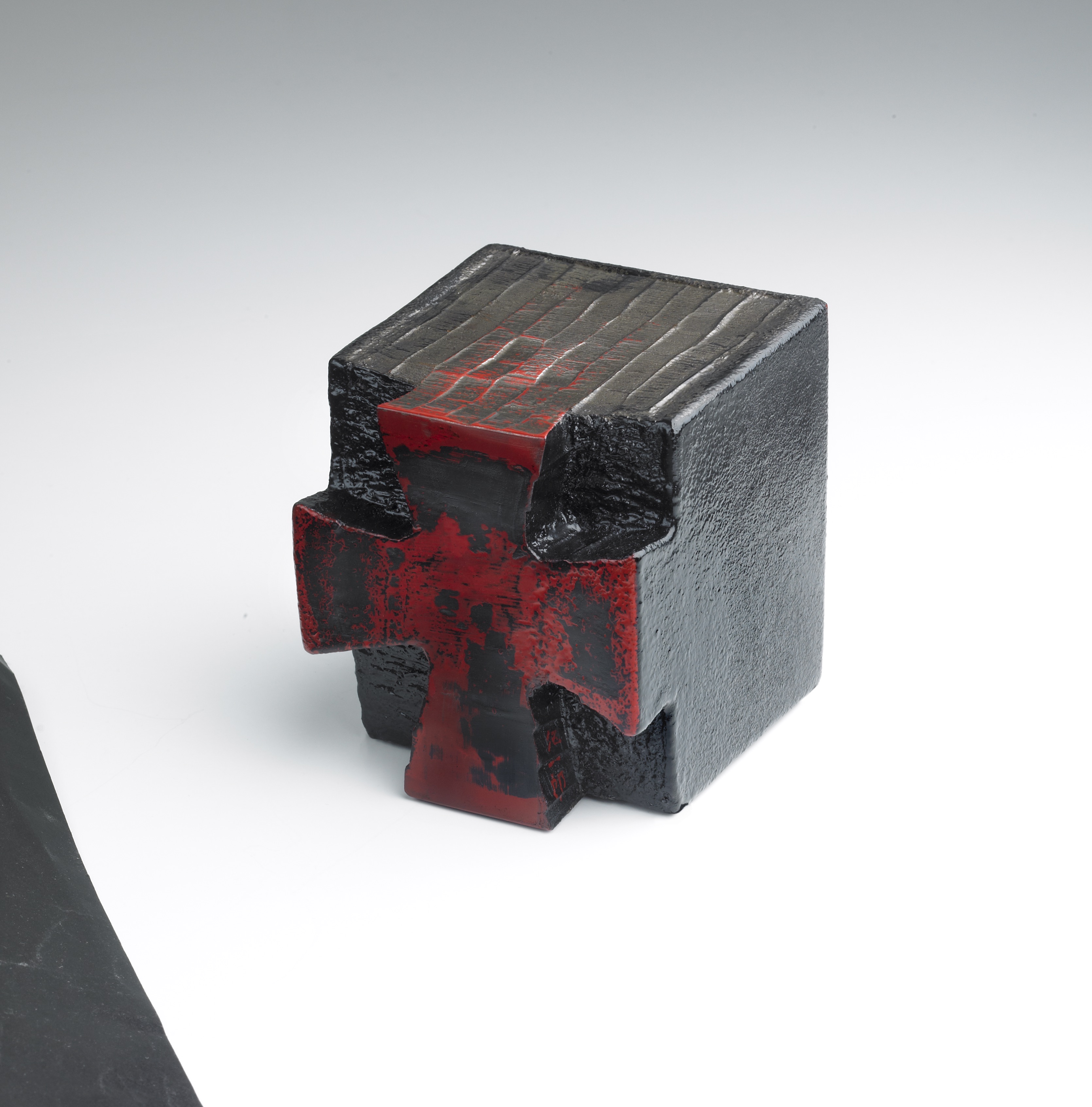
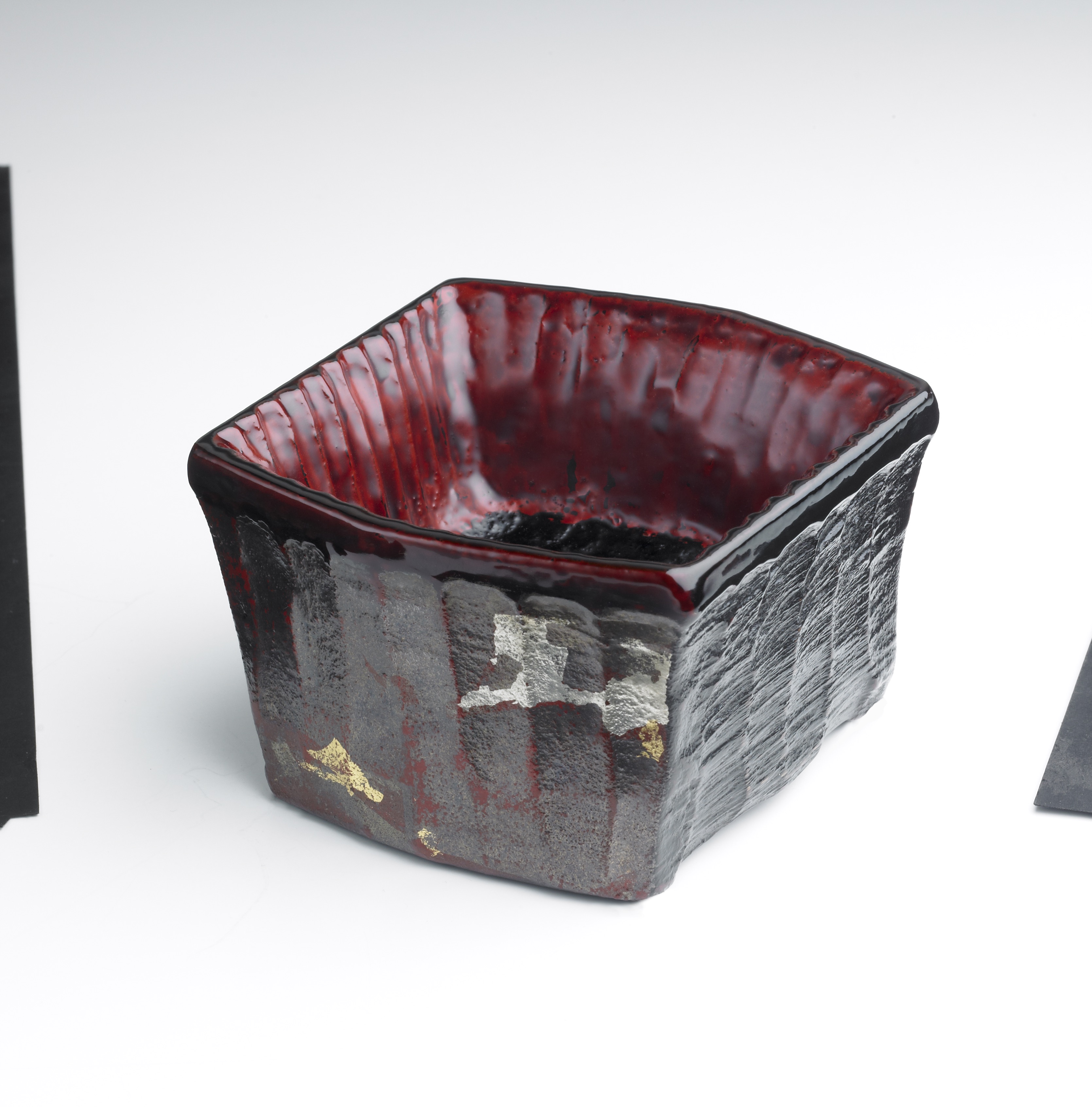
Two Vessels – entitled Jiju (cross) and Masu (measuring container) show a complex balance of geometry and texture that draws the viewer in to their mysterious, primitive forms, given great life and depth by the use of red and metallic finishes.
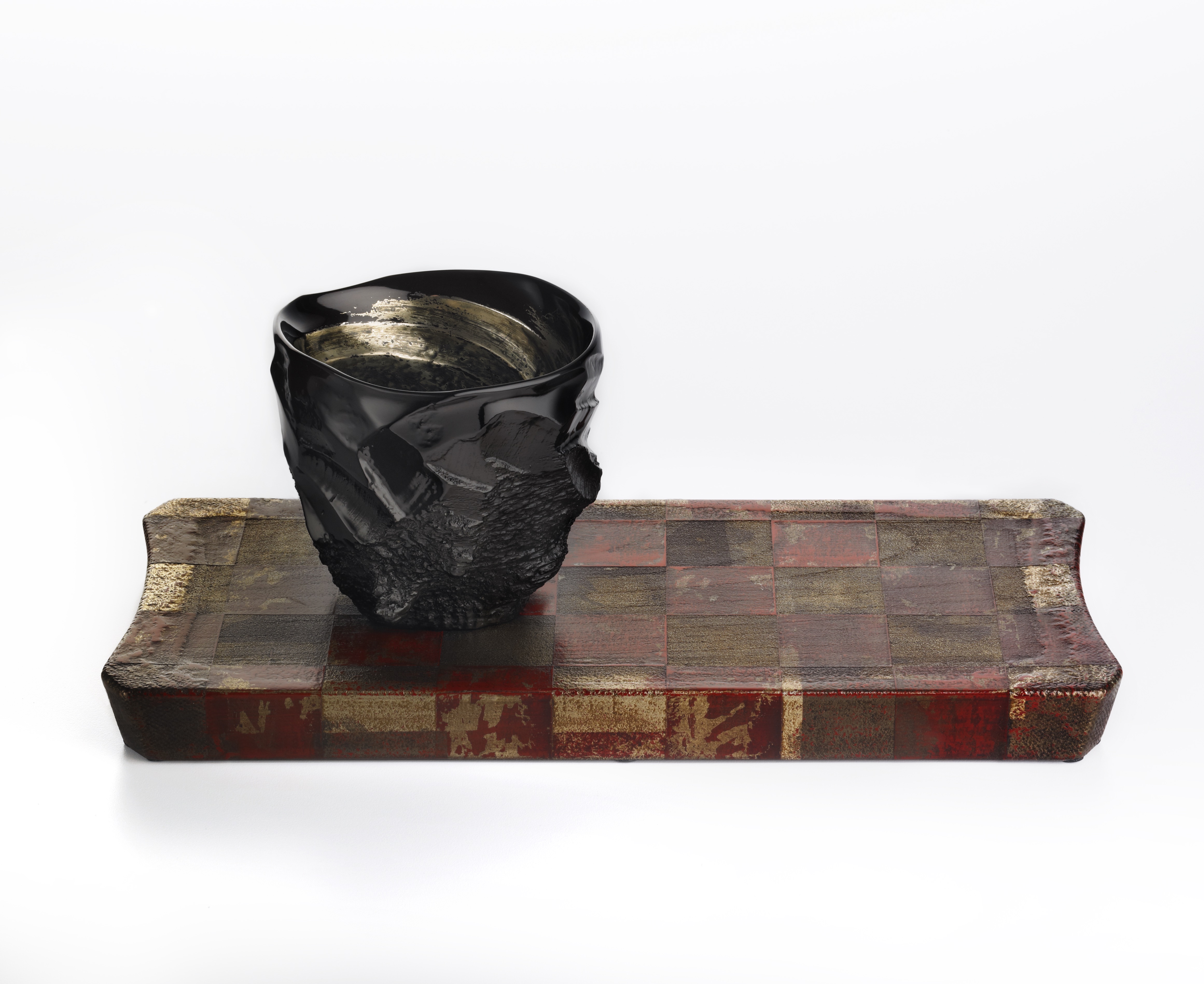
Fujino’s current work Iwahai Ryuten explores the traditional tea-bowl, chawan, – a vessel that expresses a central traditional element of Japanese life – the Way of Tea. The bowl is first carved from a single piece of camphor, contrasting smooth with rough in a range of textures to create a complex form with great tactile quality that sits naturally in the hands. Lacquering enhances the textures, adding colour and metallic reflection, in a transparency that never eclipses the core material.
The full depth of Fujino’s pieces reveal themselves slowly, prompting speculation regarding both intent and technique.
Simon Pilling, MA, RIBA, FRSA is a graduate of Sotheby’s MA in East Asian Art and is based in London, UK. He is a member of the Asian Art in London group of dealers and specialises in 20th century and contemporary Japanese lacquer.
Simon Pilling East Asian Art & Interiors
PO Box 40062 London N6 6XB
Comments
I loved this article. I had the great pleasure of witnessing a Master Japanese Laquerer when I visited Japan. The intention toward one accord with each piece is a true wonder!
Your posts in this blog really shine! Glad to gain some new insights, which I happen to also cover on my page. Feel free to visit my webpage Webemail24 about Food Delivery and any tip from you will be much apreciated.
Hey, if you are looking for more resources, check out my website Seoranko as I cover topics about Card Games. By the way, you have impressive design and layout, plus interesting content, you deserve a high five!
I know a lot of folks whom I think would really enjoy your content that covers in depth. I just hope you wouldn’t mind if I share your blog to our community. Thanks, and feel free to surf my website ArticleHome for content about Website Traffic.
Having read your posts. I believed you have given your readers valuable information. Feel free to visit my website Autoprofi and I hope you get additional insights about Auto Export as I did upon stumbling across your site.
I am genuinely thankful to the owner of this website for sharing his brilliant ideas. I can see how much you’ve helped everybody who comes across your page. By the way, here is my webpage Articlecity about Website Design.
Great job site admin! You have made it look so easy talking about that topic, providing your readers some vital information. I would love to see more helpful articles like this, so please keep posting! I also have great posts about Relationship Therapy, check out my weblog at Articleworld
You’ve written terrific content on this topic, which goes to show how knowledgable you are on this subject. I happen to cover about Construction Industry on my personal blog Article Sphere and would appreciate some feedback. Thank you and keep posting good stuff!
Hey, I enjoyed reading your posts! You have great ideas. Are you looking to get resources about Perfumes or some new insights? If so, check out my website Article Star
Amazing Content! If you need some details about about Website Promotion than have a look here UY9
Interesting piece, Simon. Fujino’s work offers a compelling counterpoint to the Western fascination with lacquer’s glossy exterior—that tension between the raw, carved core and the polished surface gives the objects a kind of quiet, ancient energy. I love how he invites us to question what we’re really drawn to in a vessel: the coating, or what lies beneath it. It also got me thinking about how technology is reshaping our perception of craft; tools like generador imagenes ia gratis can help us experiment with textures and finishes in new ways, yet they still can’t replicate the tactile depth of a hand-carved chawan. Thanks for shedding light on such a thoughtful contemporary artist.
This is such a fascinating piece on Fujino Seiichiro’s work. I love the idea of exploring the tension between surface and core — it’s a reminder that the most compelling objects, much like good stories, reveal their depth gradually. The way the Standing Tray balances raw carved wood with polished, metallic finishes sounds almost paradoxical, yet that contrast is clearly what makes it so magnetic. It also makes me think about how much patience and technical mastery goes into this craft, much like the careful step-by-step process you’d find in a detailed guide such as gothic 1 remake schlösser knacken lösung — all about methodical attention to detail. Thank you for sharing this perspective on contemporary lacquerware; it certainly deepens one’s appreciation for both the tradition and the innovation happening within it. I’ll be keeping an eye out for more of Fujino’s work.
This is such a fascinating perspective on lacquerware. The tension Fujino creates between the polished, reflective surface and the raw, carved core really challenges us to think about what draws us to an object—not just its exterior beauty, but the story and materiality beneath. I love the idea of the distressed silver leaf on *Standing Tray* reading as “memories” of past displays; it gives the piece a quiet, layered history. And his exploration of the *chawan* in *Iwahai Ryuten* sounds like a beautiful continuation of that dialogue between tradition and contemporary expression. It makes me want to learn more about how artists balance heritage with innovation. For anyone interested in broader discussions of craft and material culture, I recently came across a thoughtful resource at RoboLibrary Landing Page that complements these themes well. Thank you for sharing this insightful look into Fujino’s work and the enduring depth of Japanese lacquer.